
The Fraying World Order

/ 2026 April - Asia Brief / Column Report / by Singularity Academy/
Putin’s bombs, Trump’s blockade, and a shattered alliance: a planet on the edge of a chain reaction
Ukraine: A forgotten front
THE BIGGEST attack on Ukrainian cities in weeks was barely over before the world’s attention had moved on. On the night of April 16, Russia launched nearly 300 attack drones, 19 ballistic missiles and a salvo of cruise missiles at Kyiv, Dnipro, Kharkiv and Odesa. At least 15 civilians were killed. In his own bedroom in Kyiv, an 11-year-old boy named Maksym died. In Dnipro, five more were killed and nearly 30 wounded. In Odesa, nine dead and at least 23 injured made it the deadliest single-day toll in the port since last autumn. But when President Donald Trump was asked at Mar-a-Lago for his reaction, his reply was telling: “I think it’s terrible,” he said, before immediately deflecting. “We are now focused, very focused on Iran.”

The interlocking crisis
That deflection captures the geometry of the unfolding global crisis. The planet is not dealing with separate wars; it is living through a single, interlocking geopolitical breakdown. The threads run from the Donbas to the Strait of Hormuz, from southern Lebanon to the corridors of NATO and on to the trading floors of New York and London. What connects them is an America that has abandoned the pretence of alliance leadership, a Russia that senses historic opportunity, an Iran that refuses to be bullied into surrender, and markets that are suddenly wide awake to the spectre of an oil shock even bigger than 1973.
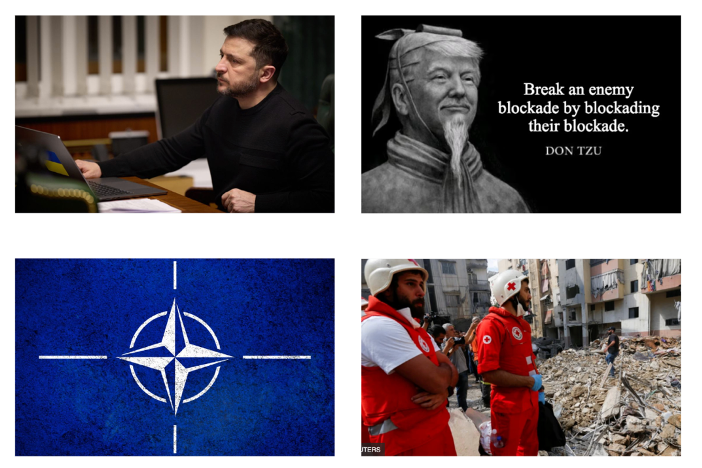
Begin where Trump himself seems least interested: Ukraine. Volodymyr Zelensky, speaking in Middelburg in the Netherlands to accept the Four Freedoms Award, was not merely talking about his own country. “Russia is waging war on the foundational lie that Ukraine does not exist, that Ukraine is part of Russia,” he said. “Their goal, built on that lie, is to wipe Ukraine off the face of the earth—and the target is broader than Ukraine.” To Zelensky, the Kremlin’s war is a global project: Russian bombing doctrine tested in Syria, Russian mercenaries active in Africa, Russian sabotage in Europe. And yet the response of the White House has been not to rally the West, but to treat Ukraine as a distraction from the president’s current obsession. When Trump says “something is happening there” and that he hopes it “gets worked out,” he sounds less like the commander-in-chief of NATO’s leading power and more like a bystander hoping the noise won’t interrupt his main show.

The Hormuz brink: blockade as policy
That main show is the Persian Gulf. On April 20, the first high-level direct talks between America and Iran since 1979 took place in Islamabad. An American delegation led by Vice-President J.D. Vance sat down with a team headed by Iran’s powerful parliament speaker, Mohammad Bagher Ghalibaf. For about three hours, they talked. The very fact of the meeting was a rupture of a taboo that had held for nearly half a century. But the talks sputtered on the only question that both sides agree really matters: Iran’s nuclear programme. America demanded that Iran dismantle its enrichment capacity. Iran, battered by weeks of American and Israeli bombing that had resumed on February 28, refused. No breakthrough. And afterwards, Trump’s frustration boiled over.
In a pair of extraordinary, all-caps social-media posts on Saturday evening Washington time—when markets were safely closed—the president made an announcement that stopped just short of a declaration of war. “Effective immediately, the finest navy in the world, the United States Navy, will begin interdicting all vessels attempting to transit the Strait of Hormuz,” he wrote. Iran had been operating a de facto toll system, selectively allowing fee-paying ships through the chokepoint. Now, Trump declared, America would impose a total blockade. “Any vessel that has illegally paid passage fees will not be safe on the high seas. We will also begin destroying the mines Iran has placed in the strait. Any Iranian who fires on us or on peaceful vessels will be blown to smithereens.”
The strategic logic, if one can call it that, was a “big blockade” to crush a “small blockade.” The practical consequences would be immense. Roughly a fifth of the world’s oil transits the Strait of Hormuz. Even a partial closure would send crude prices soaring, perhaps beyond $150 a barrel. A full American-imposed blockade, enforced by interception and counter-mining operations against an Iranian military that almost certainly would fire back, would not be a crisis: it would be a structural break in the global economy. The New York Times called it what it plainly is—a clear act of war under international law.
By Sunday morning, oil traders were bracing for a wild Monday open, and equity futures were signalling a plunge. Tehran’s student news agency, meanwhile, published photos of uniformed troops deployed along the coastline, a warning that Iran was preparing not just for a naval skirmish but for the possibility of land incursions.
NATO: the trust deficit becomes a strategic fracture
Yet Trump’s declaration is not just an oil-market problem. It is a problem for the entire architecture of alliance management that has been crumbling since his return to power. The NATO allies, already shell-shocked by the president’s erratic pivot, were not consulted. At a defence forum in Paris on April 24, a parade of European officials and senior figures from the alliance aired their grievances with uncharacteristic bluntness. The United States had launched its renewed military campaign against Iran on February 28 without giving prior notice to NATO or its allies, they complained. One senior French official remarked waspishly that “strategic solidarity cannot survive strategic surprise.”
The alliance is now split, far more than during the 2003 Iraq crisis. Britain has oscillated from “no participation” to “limited defence” to substantive involvement, and its prime minister has been humiliated by Trump’s public dismissal of the Royal Navy’s carrier as a “toy.” France has sent its own carrier to protect its interests and its president, Emmanuel Macron, who once called NATO “brain dead,” is now using that language as diplomatic common sense.
Spain has condemned the war outright and stated it will not take part in what it calls an illegal conflict. Even Germany, lately the target of Trump’s fury over its defence spending, has kept its distance. The president’s earlier threats to seize Greenland and his ridicule of allied leaders have not been forgotten. As a senior European diplomat told this newspaper in Davos earlier this year, “The trust capital has been spent. Washington is now a risk factor we must price in, like weather.”
Coldness in Europe has had a direct effect on the Iran file. Without the use of British bases, French and Italian airspace, and the logistical mesh that only allies provide, American power projection against Iran becomes vastly more difficult. NATO’s secretary-general, trying to hold the fragments together, has insisted that the alliance “remains the platform for American military reach,” but the truth is uglier. America needs the allies, but Trump treats them as vassals. The allies need America, but no longer trust it to tell them the truth, let alone defend them. The result is exactly the “paper tiger” dynamic that the president has accused NATO of being a mutual weakening.
The Levant: a “ceasefire” in name only
While the Strait of Hormuz drama grips the headline writers, the eastern Mediterranean is burning in a lower key but with almost ritualistic brutality. On April 23, Trump announced from the Oval Office that the temporary truce between Israel and Lebanon would be extended by three weeks. “The meeting went very well,” he said. Within the same 24-hour news cycle, Israeli jets struck what they called Hizbullah military infrastructure in the south Lebanese towns of Kherbet Selm and Touline. Hizbullah fired rockets into northern Israel in retaliation for what it said were Israeli violations. Israel’s ambassador to the UN, Danny Danon, declared the extension “not 100% certain,” and the defence minister, Israel Katz, in a recorded statement, said Israel was “waiting for the green light from the United States to completely eliminate the Iranian regime,” promising to knock Iran back to a “dark Stone Age.” In other words, the ceasefire was a ceasefire in name only, and the logic of the conflict is pulling inexorably towards a wider regional war—one in which Israel openly wants to destroy the Islamic Republic, not merely deter it.
The Lebanese are caught in the pincers. Since March 2, when hostilities reignited after a previous brief pause, Israeli strikes in Lebanon have killed at least 2,483 people and wounded 7,707, according to the disaster-management agency. In the latest horror, an Israeli air strike on April 22 first hit a car in the southern town of Touline, killing two people, and then struck the house where two female journalists had taken refuge.
One of them, Amal Khalil, was killed. When Red Cross ambulances arrived, the Israeli military fired stun grenades and shots that hindered the rescue. Journalists are not collateral in this war; they are targets, and so are the medics who try to save them. The conflict is expanding so swiftly that a three-week pause proclaimed by the American president is being ignored by his own closest regional ally even as he speaks.
Oil, markets, and the spectre of a supply shock
Taken together, these threads tighten into a knot that will choke the global economy if it is not unpicked. The most immediate feedback loop is between Trump’s Hormuz blockade threat and the price of oil. If the American navy tries to stop commercial traffic that Iran deems permissible, the risk of a direct military exchange between American destroyers and Iranian fast-attack boats, shore-based missiles and mines is almost certain.
No insurance company will cover a tanker heading into a war zone where the belligerents are actively mining the sea. The world’s daily flow of roughly 20 million barrels through the strait would shrink drastically. Even a partial closure of a couple of weeks would be enough to trigger a global recession, the first since the pandemic. Stock markets, already jittery over the pause in trade and the dollar’s swings, would sell off savagely. The VIX index would spike. Emerging-market currencies would crash. The political fallout for Trump, whose electoral coalition depends on cheap gasoline and a rising Dow, would be immediate and fierce. His own Treasury secretary, who is known to favour a more transactional approach, has been caught in the background of the debate, evidently attempting to pull the president back from the brink. So far, he is losing.
A world of three blocs
Politically, the impact is a fracturing of the post-Cold War landscape into three rough blocs. There is a revisionist axis—Russia, Iran, and loosely their partners—that wants to crush the American-led order by force. There is a West that is more divided than at any point since Vietnam, with a Trumpian America increasingly seen as a rogue actor by its friends. And there is a vast, watchful middle—India, the Gulf states, Brazil, South Africa, China—that is hedging furiously, calculating how to pay for oil in alternative currencies, and inviting both European and Chinese leaders on state visits. The European pivot towards Beijing, initiated in part by Trump’s Greenland threats, is now accelerating not out of affection for China but out of self-preservation against Washington’s unpredictability.

The permanent state of emergency
What is taking shape is not a world war but a layered, global crisis of authority. Each theatre is feeding the next. Russia’s overnight terror in Ukraine is interpreted by Iran as evidence that America will not seriously confront a nuclear-armed power that kills civilians. Iran’s ability to drag out negotiations and menace the oil supply is interpreted by North Korea as evidence that nuclear brinkmanship pays. NATO’s paralysis in the face of American unilateralism is understood by all as evidence that the alliance cannot manage a single crisis, let alone three at once. And the markets, always the most unforgiving of audiences, are starting to price in a world in which the insurance of American hegemony has been cancelled.
On April 16, President Zelensky asked his audience in Middelburg to observe a minute of silence for the dead of Ukraine. It was a reminder that the most basic freedom—freedom from annihilation—is not guaranteed. A few days later, Trump was threatening to “blow to smithereens” anyone who challenged his new blockade. That contrast, between a plea for justice and a threat of devastation, is the world made by the current American presidency. The question for Monday morning is not whether the oil price will jump. It is whether we have already slipped, without quite noticing, into a permanent state of emergency in which all the old certainties—the alliance, the liberal order, the sanctity of the civilian—are no longer operating as they should. If the Strait of Hormuz burns, it will not burn alone. Every front will feel the heat.

Comments